THE MOCKUS INTERVIEW RETOLD
Professor Emeritus of Civil and Environmental Engineering
San Diego State University, San Diego,
California
PRELUDE
In the winter of 1993, the Late Pete Hawkins and I met in Denver
while we were both lecturing
at an Army Corps of Engineers' Technical Conference.
I had known Pete for a few years and was very familiar with his work.
It did not escape my attention that he had a good
track record on curve number hydrology.
Over the next two years, we toiled to complete the paper that we had set out to write.
Pete proved to be a meticulous coauthor; to this date,
my memory of the experience
still resonates positively in my mind. Pete needed to be convinced of my thoughts on the
subject; conversely, I may add, I needed to be convinced of his.
As planned, the paper went through the customary steps for
journal publication. There were three
discussions, to be duly followed by the authors' closure.
As
we prepared to write the closure, I had a
strong feeling that to do proper justice to the
methodology, we needed to get in touch with Victor Mockus,
Soil Conservation Service engineer of the 1940's, who was
widely recognized as a principal author. [In 1994, SCS
became the Natural Resource Conservation Service, subsequently to be
referred to as NRCS].
The original release of the methodology had been dated 1954. Vic
had retired in the 1960's, after a productive career in government service,
and ostensibly had been out of touch with SCS since then.
PREPARATION
I contacted Don E. Woodward, who at the time (1996) was
National Hydraulic Engineer at NRCS, for help in reaching Mockus.
Don encouraged me to do it,
but cautioned that it could be a slippery road, since about three decades had
elapsed and he (Don) understood that Mockus had not been in touch with SCS since
his retirement in the 1960's. I have always enjoyed a challenge.
At the time I
felt that if I was
successful in convincing Vic to briefly step out of his self-imposed
isolation, that our work would benefit inmensely, not to mention
the benefit to acrue to the profession at-large.
In July of 1996, I spent a few days in Washington, D.C., purposely to
interview Mockus. It did not take me too
long to find a working number for him.
TOPICS FOR DISCUSSION
That evening, I prepared myself dutifully for the interview,
which was to take place the
following day.
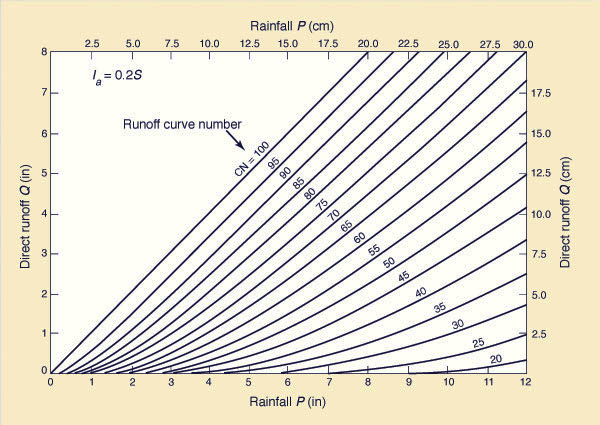
THE MOCKUS RUNOFF EQUATION
The overriding question
in my mind, and presumably that of countless users of the curve number
method, was the origin of the so-called Mockus runoff
equation. In other words, how did Vic come up with
Eq. 3,
as shown in
Mockus proceeded with a calmness
that revealed that it was not the first time
that he had been asked the question. He
stated that he had zeroed in on that equation, "One evening, after dinner, seeing that it fitted the data very well, and after having tried many other alternative relations"
(NRCS: Miguel Ponce conversation with Vic Mockus).
It should be mentioned
that Mockus' equation unmistakingly states a complete opposite truth
to that of the classical Horton infiltration equation,
which preceded Mockus' work by more than two decades (Horton, 1933). Indeed, while Mockus' equation
states that retention and runoff are
directly related, Horton's equation states no such thing.
[We surmise that the recognition of this fact may
have been the source of many spirited arguments amongst scientists
in the early days of
infiltration modeling].
Herein lies the essence of the difference between these two historic approaches
to infiltration modeling, underscoring the intrinsic value and, therefore,
demonstrated permanence, of Mockus' approach
INITIAL ABSTRACTION
Initial abstraction Ia is
the rainfall which takes
place before the start of runoff; it is defined as Ia
= λ S, in which λ = initial abstraction ratio,
and S = potential maximum retention (of the study site).
The value λ = 0.2 has been used in the U.S. and most other countries
since its inception in 1954. However, Mockus was of the opinion
that if the data warranted,
the value could be changed to reflect local field
conditions. Extensive curve number experience,
particularly in the U.S. and other countries,
appears to point in that direction
APPLICABILITY ACROSS BIOMES
It was Mockus and his associates
who gave the method the name "runoff curve number,"
and this name
was
readily accepted for usage throughout the world.
Yet the method's paternity is recognized as SCS's,
which, four decades later, in 1994, became
NRCS. Thus, the method's original scope has been clearly defined
from the start:
Hydrologic modeling, with the objective of supporting
flood and erosion control studies
in small agricultural
watersheds. In the 1996 interview, Mockus noted that the field data used to
underpin the method's development
had varied in scale from 0.1 to 10 square miles. This fact all but reduces the
method's scope to direct runoff,
as opposed to
It is now widely recognized that the method's best performance is for agricultural watersheds, for which it was originally developed. The method's applicability has since
been extended to urban sites.
LIMIT TO WATERSHED SIZE
The comments of the previous paragraph take on a life of their own when
it is realized that, over the years since its introduction, the method's apparent simplicity
led to its wide popularity, which encouraged many
practitioners to apply
the method beyond its original scope, that is, for larger watersheds,
which were not necessarily of
agricultural type.
Mockus himself, when questioned on the practical upper
limit to watershed/basin size for use of the curve number methodology,
mentioned the 400-square mile
limit, in reference to the upper limit for midsize
watershed/basin runoff analysis
CURRENT MODELING PRACTICE
The NRCS runoff curve number method is now widely understood for what it is:
A rainfall-runoff model with a definite
conceptual basis, amply supported by field data, and officially
endorsed by a major federal agency. As Mockus stated
in the 1996 interview,
he saw no limit to a basin-scale application
of the runoff curve number equation, other than that which is
imposed by spatial rainfall uniformity.
Despite more than two decades of intensive research, the resolution
of the λ argument still awaits an official decision by NRCS (2026). A definite answer to this question remains elusive.
A change in λ from the current 0.2 value to
a possible future value of 0.05 will trigger a complete change in table runoff curve numbers, with the perceived reluctance to change of a long-established
practice.
REFERENCES
Hawkins, R. H., T. J. Ward, D. E. Woodward, and J. A. Van Mullem. 2009.
Curve Number Hydrology: State of the Practice.
Report of ASCE/EWRI Curve Number Hydrology Task
Committee, 106 p.
Hawkins, R. H., 1984. A comparison of predicted and observed runoff curve
numbers. Proceedings, Specialty Conference,
Irrigation and Drainage Division,
ASCE, 702-709.
Hawkins, R. H., 1993. Asymptotic determination of runoff curve numbers
from data. Journal of the Irrigation and Drainage Division, ASCE,
119(2),
334-345.
Horton, R. E. 1933. The Role of Infiltration in the Hydrologic Cycle.
Transactions, American Geophysical Union, Vol. 14, 446-460.
Ponce, V. M., and R. H. Hawkins. 1996.
Runoff Curve Number: Has It Reached Maturity? Journal of Hydrologic Engineering, Vol. 1, No. 1, January.
Ponce, V. M. 2014.
Engineering Hydrology: Principles and Practices, Prentice-Hall, Englewood
Cliffs, New Jersey, |

| 260209 |